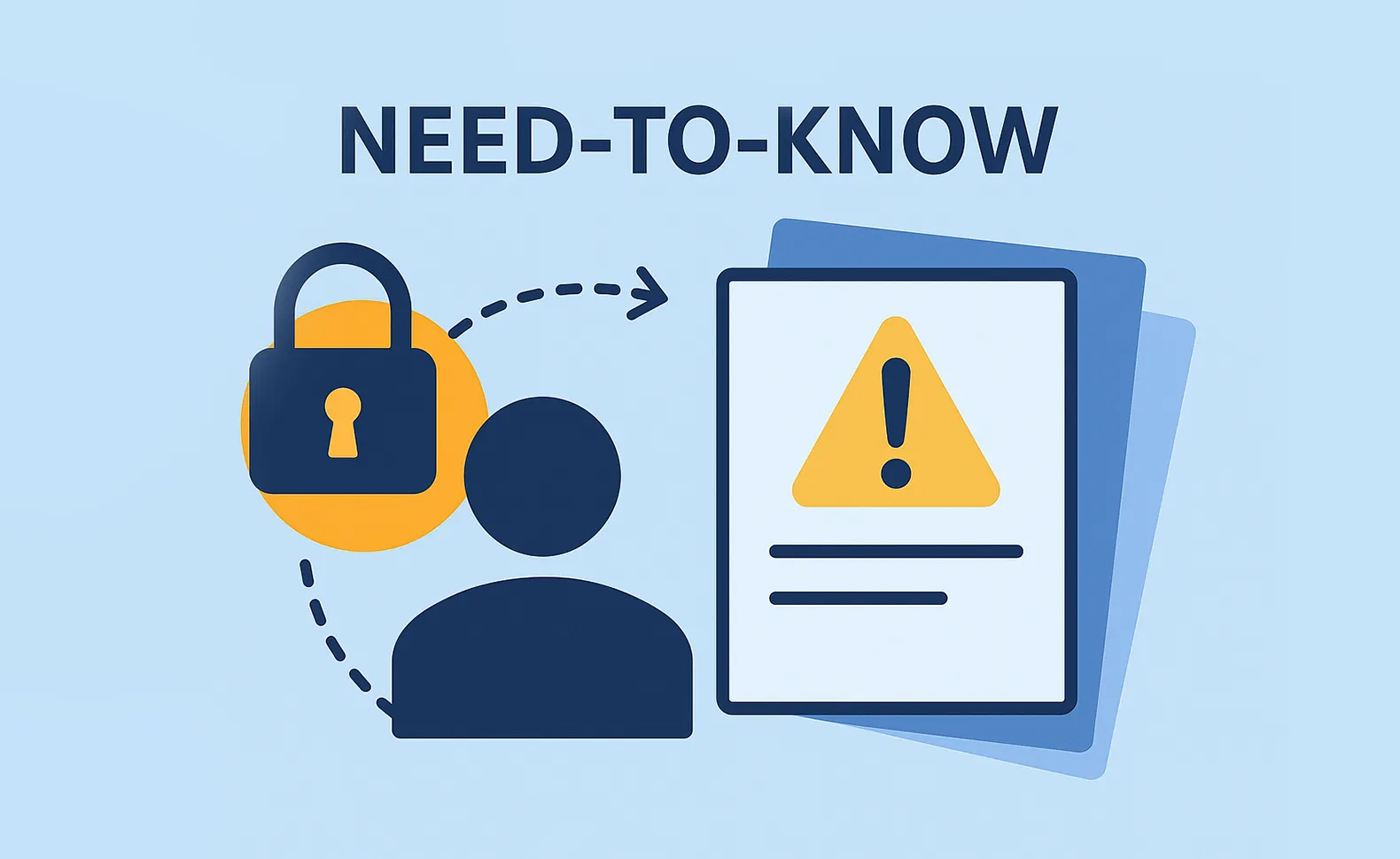

The Need-to-Know Principle is a core security doctrine which dictates that a person should only have access to the specific data, files, or systems necessary to perform their immediate job duties—and absolutely nothing more.
Even if you have the highest security clearance in an organization, you don’t get a free pass to look at everything. If you don’t need it to do your work today, you don’t get to see it.
How It Works
Think of the Need-to-Know principle as the granular enforcement layer of security. It is often paired with the Principle of Least Privilege (PoLP), but they have slightly different focuses:
- Least Privilege: Focuses on privileges and permissions (e.g., “You only have read-only access, not admin rights”).
- Need-to-Know: Focuses on the data itself (e.g., “You have read-only access, but only to Project Alpha’s folders, not Project Beta’s”).
Key Characteristics
- Departmental Silos: Compartmentalization ensures that a breach in one department doesn’t automatically compromise the entire organization.
- Dynamic Access: Access isn’t permanent. If you finish your assignment on a project, your “need to know” expires, and your access should be revoked.
- Human-Centric: While technology (like Access Control Lists) enforces it, the principle relies heavily on policy and human discretion.
Real-World Examples
| Scenario | Application of “Need-to-Know” |
|---|---|
| Healthcare | A cardiologist can view your heart scan results, but they cannot browse your psychiatric evaluation records unless it directly impacts your current treatment. |
| Military/Gov | A soldier may have a “Top Secret” clearance, but they are only given the specific GPS coordinates and blueprints for their upcoming mission. |
| Corporate HR | An HR generalist needs access to employee healthcare enrollment forms, but they do not need access to the company’s proprietary software source code. |
Why It Matters
The Blast Radius Argument: If a hacker compromises an employee’s credentials, the damage is strictly limited to whatever that specific employee had access to. It prevents lateral movement across a network.
It also protects against the insider threat (curious or disgruntled employees snooping through sensitive data) and ensures compliance with strict data privacy laws like GDPR and HIPAA.
Are you looking to implement this principle within a specific IT network, or are you studying it for a security certification like CISSP?