
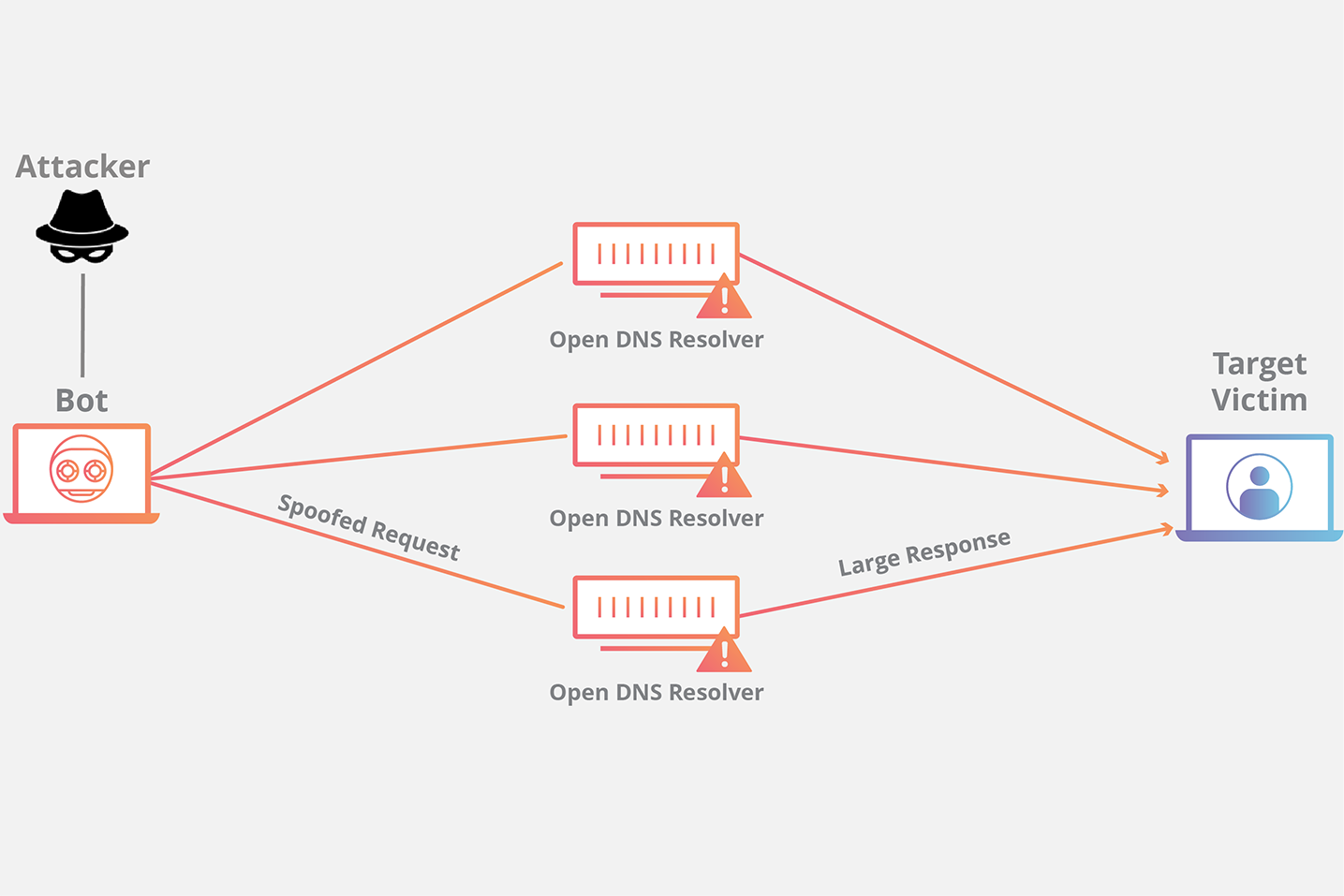

A DNS Amplification Attack is a popular and highly effective form of a Distributed Denial of Service (DDoS) attack. It relies on two core vulnerabilities: open DNS servers and IP address spoofing.
The goal is to overwhelm a victim’s network or server with an unmanageable volume of traffic, causing it to crash or become unavailable.
How It Works: The Analogy
Imagine a malicious prankster wanting to overwhelm someone’s physical mailbox.
- The prankster sends thousands of letters to various large companies asking for their massive, 500-page product catalogs.
- However, on the return address of every single letter, the prankster writes the victim’s home address instead of their own.
- A few days later, the victim’s mailbox is completely buried under thousands of heavy catalogs they never asked for.
The Technical Mechanism
In the digital world, this attack exploits the Domain Name System (DNS) and uses UDP (User Datagram Protocol), which doesn’t require a “handshake” to verify who is actually sending a request.
1. Spoofing the Target IP
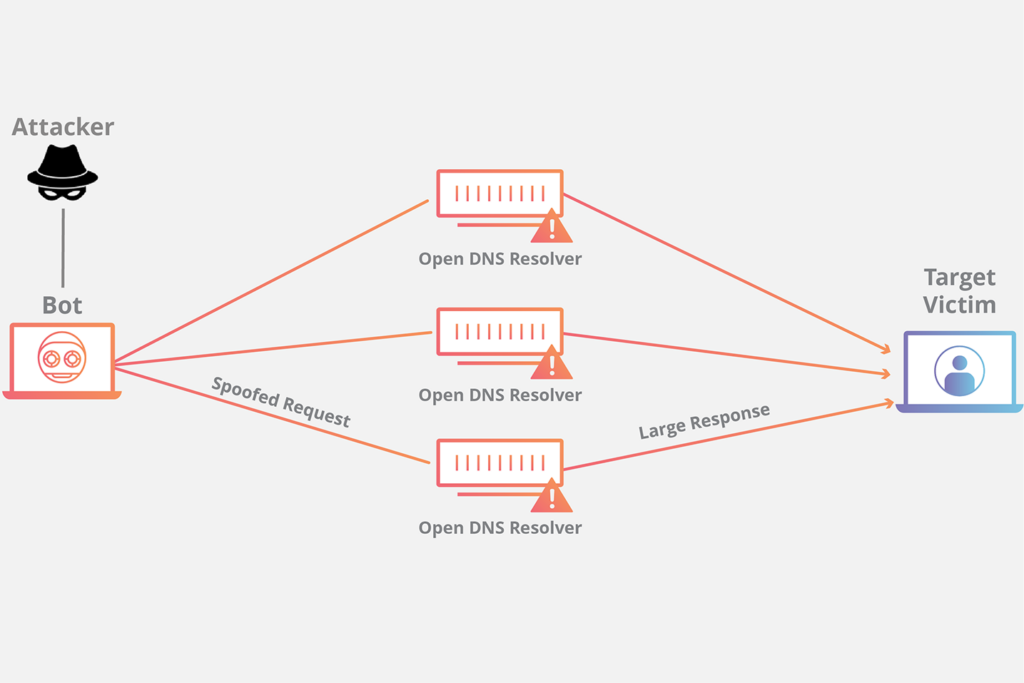
The attacker configures a botnet (a network of compromised computers) to send a barrage of DNS lookups to open DNS resolvers. Crucially, the attacker spoofs the source IP address in the packet headers, making it look like the requests are coming directly from the victim’s server.
2. Exploiting Open Resolvers
The requests are sent to Open DNS Resolvers—servers configured to resolve domain names for anyone on the internet.
3. The Amplification Factor
To maximize damage, the attacker requests specific, data-heavy records (often using the ANY or TXT commands) or leverages EDNS (Extension Mechanisms for DNS).
- The Request: Might only be about 60 bytes.
- The Response: Can easily be up to 4,000 bytes.
This represents an amplification factor of up to 70x, meaning a relatively small amount of attacker bandwidth turns into a massive tidal wave of traffic hitting the victim.
4. Overwhelming the Victim
The open DNS resolvers send these massive responses directly to the spoofed IP address (the victim). The victim’s network bandwidth and resources are completely consumed trying to process this junk data, knocking them offline.
Mitigation Strategies
Defending against a DNS amplification attack requires a mix of securing individual servers and working with internet service providers (ISPs).
- Source Address Validation (BCP 38): ISPs can implement filters that reject traffic leaving a network if the source IP address doesn’t match the network’s actual IP range. This prevents attackers from spoofing IPs in the first place.
- Closing Open Resolvers: Network administrators should configure DNS servers to only respond to queries from authorized internal users, rather than the entire internet.
- Response Rate Limiting (RRL): DNS servers can be configured to limit the rate at which they respond to identical requests from the same source, mitigating how much traffic they can be tricked into generating.
- Anycast Threat Mitigation: Using a distributed network (like a CDN or specialized DDoS mitigation service) allows the massive influx of traffic to be absorbed and filtered across multiple global data centers instead of hitting a single target.